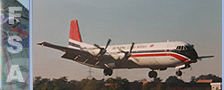
Garry Russell wrote:I watched Randel and Hopkirk deceased the other day and they flew back from the South of France in a Red Square Trident
Garry
I was equally entertained to see them all fly down to Monte via Nice in a Pan Am 707 whilst the interior set was ITC's generic Comet influenced interior which has doubled up for many aircraft interiors over the years, the aeronautical equivalent of their infamous white Jag over a cliff - if you are watching any ITC and the baddie is driving a white Jag, they will be toast over a cliff very shortly.
Great entertainment filmed on a shoestring, something some modern CGI obsessed producers could learn about.
RS Tridents are common in The Saint and every now and again, a VC10 pop's in too The Champions tend to show a lot of PAA 707's as the three hero's jet all over the world from Geneva but equally, the HS125 gets quite a few outings (looks like the HS demonstrator) as does the Dove. Watched one a few weeks back (wrote the reg down somewhere!) which showed them in a Dove taking off.. then it showed a few clips of them in the air (a different Dove) and once more on landing the original Dove
Watched the film last night. Mostly filmed at Filton with a six engined Ashton. There were only a couple of shots of LHR
In one scene the pilot is being tested on flying to a marker beacon by listening to the morse signals with the intention that he had to fly into the cone of silence directly above the beacon. To do this he had to wear blacked out goggles. I thought later why would you need goggles, it is not as if you could see the beacon and fly towards it.
The other nice thing was the way the crew have to give a thumbs up before the start of the take off roll.
If God had meant us to fly, he would have given us tickets.
The film with Jimmy Stewart and the Reindeer aircraft is 'No Highway (in the Sky)' based on the book by Neville Shute. Interestingly the main plot is about the phenomenum of metal fatigue, which was still a little known effect, although it was to subsequently prove the undoing of the Comet 1.
Another poster here mentioned the similarity of the Phoenix 1 take-off problems to the Comet 1. The author of the book, David Beaty, had previously met the unfortunate pilot who failed to get off at Rome and it's believed, he loosely based the plot around that experience.
Whilst the book is out of print, it's a good read and handles the 'revelation' in more detail than the film does. Notwithstanding that, the film is very much worth a look and is in my own collection.
When explaining the Cone of Silence in the film, the training captain amplified the explanation by showing a simplistic diagram.
I must instal the 'Radio Range 4' add-on into FS9 sometime soon then, copy the 'appropriate gauge' into Jen's Comet 1 and I can then recreate the book/film...!
crisso wrote:Another poster here mentioned the similarity of the Phoenix 1 take-off problems to the Comet 1. The author of the book, David Beaty, had previously met the unfortunate pilot who failed to get off at Rome and it's believed, he loosely based the plot around that experience.
I was reading up on that incident last night after watching the film. The pilot of the Rome a/c, G-ALYZ, Capt Foote, was transferred to Yorks after the inquiry and ironically he was the Pilot of the a/c that first spotted the wreckage of Comet YV that broke up shortly after TO from Calcutta from a structural failure as it flew through a thunderstorm (sound a familiar theory?)
If God had meant us to fly, he would have given us tickets.
Elaborating on my previous post, I believe the unfortunate Capt. Foote met David Beaty, after his Comet Take-off accident, when the latter was researching and preparing a factual book on aircraft accidents, and the former repeatedly protested his innocence and was very aggrieved for originally getting the blame. I also understand that Capt. Foote, during his later career on Freighters, was subsequently awarded a medal for an act of outstanding airmanship - an oblique reference to which incidentally, is made in the book 'Cone of Silence'.
Personally, I believe the step from piston engined airliners to the Comet was as great a step, if not greater, in technology than that, from Subsonic jet airliners to Concorde and completely new techniques had to be learned, despite lack of sophisticated instrumentation and the controversy over the original power assisted controls possibly not helping either. Also, I have read from Aviation journalists that at the time of the Comet construction, De Havilland did not take any critical comment kindly to their products since, some pilots had commented on the very thin fuselage metal skin used, etc.
Once again if you are interested in this era of aviation (early-mid 1950's, Comet and similar, etc.), I re-iterate, try and get hold of the novel 'C.O.S.'. (Also, David Beaty's other aviation novels are good too - particularly 'Heart of the Storm' (again, 'very loosely' based on the Avro Tudor/BSAA accidents).




 The Champions tend to show a lot of PAA 707's as the three hero's jet all over the world from Geneva but equally, the HS125 gets quite a few outings (looks like the HS demonstrator) as does the Dove. Watched one a few weeks back (wrote the reg down somewhere!) which showed them in a Dove taking off.. then it showed a few clips of them in the air (a different Dove) and once more on landing the original Dove