Re: Another crazy Russian idea?
Posted: 13 Aug 2010, 17:42
There were three experimental gas turbine locomotives and one experimental gas turbine powered APT on BR. The first gas turbine powered loco was ordered by the Great Western Railway from the Swiss firm Brown Boveri but was delivered to BR in 1949, and was a gas-turbine electric contraption, nicknamed "Kerosene Castle" by railwaymen. That was followed by a British built version from Metropolitan-Vickers in the early 1950s. Both were in regular use for a number of years. "Kerosene Castle" was eventually sent to the Union International des Chemins de Fer in Geneva but was recently re-patriated and is currently preserved but inoperable. The Met-Vick loco was eventually converted into a straight AC electric loco for training drivers on the new West Coast electrification in the late 1950s, including a small classroom at one end of the loco where the gas-turbine used to be. It was eventually scrapped in Bilston.jonesey2k wrote:Didn't BR or one of the companies produce an experimental GT loco? I think I read sowhere that it used the turbine for high speed cruising and a normal diesel for slow speed and shunting.
The third gas-turbine loco is even more bizarre. It was GT3, built in the early 1960s by English Electric, but for some strange reason best known to English Electric it was built with a conventional steam loco layout, rumoured to be the chassis of a BR Standard Class 5 steam loco, with the gas turbine hosed in a long bonnet, a cab behind the bonnet, a steam engine like tender for the fuel oil, and even the 4-6-0 coupled wheel arrangement just like a steam loco! Clearly, the visibility from the cab would have been minimal, and considering it was being built at the same time as cab-forward diesel locomotives quite why such an archaic layout was adopted is a mystery. It didn't last long.
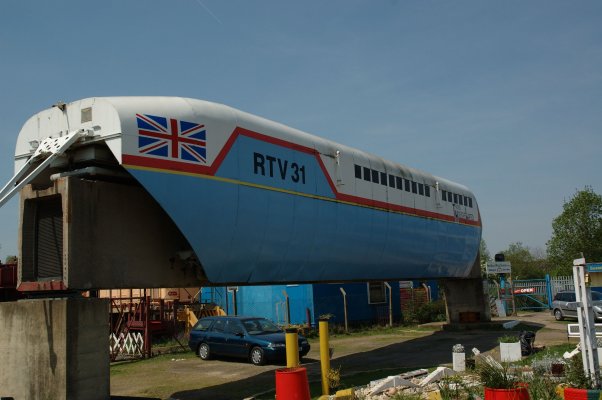
The final experiment to date in Britain with gas-turbines was the APT-E which was equipped with a number of British Leyland (read it and laugh) gas turbines driving electric motors. The BL gas turbine was developed from a proposed truck engine which given BL's notoriety for patchy quality control would have been a lottery, just imagine a gas turbine powered fuel tanker with a Friday afternoon special engine deciding to throw a blade on the motorway...anyway in the APT the engines were used to power the train up to some record breaking speeds, but the cost of the fuel used in the 1970s and the ongoing problems with the on-off programme with the APT meant no more were built and future APT units were planned for electric operation.
Finally, whilst BR didn't get anywhere with gas-turbine propulsion, France, ever wanting to be different, operated a number of RTG units (Rames Turbine a Gaz) on services from Paris to non-electrifed lines in Brittany, Normandy and around Lyons. They continued in operation for many years, only recently being replaced by electric or new generation diesel units. A number of sets were exported to the US for Amtrak, who also built their own licence-built version. Most are still in service in the US. In contrast, the Canadian Turbotrains originally used on Canadian National, and later Via Rail services in the late 1960s have now been withdrawn, but also were quite successful and attained a number of North American speed records. Union Pacific had a couple of gas turbine experimental locomotives, and the New York Central tried equipping a Budd railcar with two military surplus jets to experiment with high speed traction, in 1966, not dis-similar to the Russian example http://www.gettyimages.co.nz/detail/JE4 ... on-Archive
Of course, with the exception of the jet powered Budd railcars, all the experiments tended to use the turbine as a generator of electric power for which it is quite suitable if thirsty. Attempts to marry the gas turbine to mechanical transmission didn't work by and large, for much the same reason as gas-turbine mechanical cars tended to have problems, mainly the attempts to match the high rotational speed of the turbine shaft to variable road speed.