My Vulcan did a Victor
Posted: 01 Jan 2010, 14:37
Now that I have a new computer, I'm getting to grips with all the high-end models I'd bought but wasn't able to use because of my old system's limitations. The fps with the Iris Vulcan wasn't so much a slide show as a still-life art class.
Anyway, I thought I'd do it 'a la TVOC', and learn all the systems, print out the manual, run through what each and every dial, button and switch was for etc etc. I did this while the aircraft, XM607, was on the pan at Edwards AFB. All well and good, and I started to do some high speed taxi runs ( you know whats coming, don't you ) deploying airbrakes and brake chute and so on. I also started familiarizing myself with the radios and had NAV1 tuned to the ILS just to see how the yellow glideslope and localiser bars moved when I lined up in on the runway. What I had yet to do was learn anything about the autopilot system, which is a bit unusual, with things like Glide pull switch, channel switches, IAS/Altitude pull switch and so on. Save that for another day, I thought.
So there I was, barrelling down RW 22 for about the fourth or fifth time and, switching to external view, I thought I would just ease the nose wheel up a tad...just a little, just to see what it looked like. The inevitable happened; suddenly I was a few feet in the air, and I chopped the throttles...but too quickly, and not wanting to hit the tarmac too hard, I re-applied power to slow the descent. Wrong ! I started climbing again, and was running out of runway to put her down, so I had no choice but to go for a circuit. I did consider leaving the wheels down to try to arrest my speed, but feared damaging them, so up they came.
I could have pressed the ESC key and ended the flight, but pride got in the way, so put it in a gentle turn to the right, trimmed it out at around 4500 ft, and tried to keep the speed down below 250 knots. I then considered my options. The Vulcan is NOT a VFR aircraft. The view out of the cockpit is very limited, but not being au fait with the intricacies of the auto-pilot, the only way I was going to get it down was by hand and eye. Bear in mind, this was genuinely the first time I'd been airborne in the Iris Vulcan.
I continued the long right turn, looking out through the copilots side window to catch sight of the airfield as it receded down the starboard side. The only thing I did have in my favour was the fact that the NAV 1 radio was still tuned to the ILS frequency, and it was by a long long curve that I eventually lined up with the localiser. I was way below the glideslope and kept pushing the throttles far more than was required. Dropped the gear at 150 knots, but was once again at risk of undershooting. In trying to correct that ( and commiting the cardinal sin of using the stick instead of the throttles ),I started some rather severe pilot-induced oscillations. Nevertheless, I smoothed it out and if I say so myself, actually touched down quite sweetly...and almost bang on the centre line !
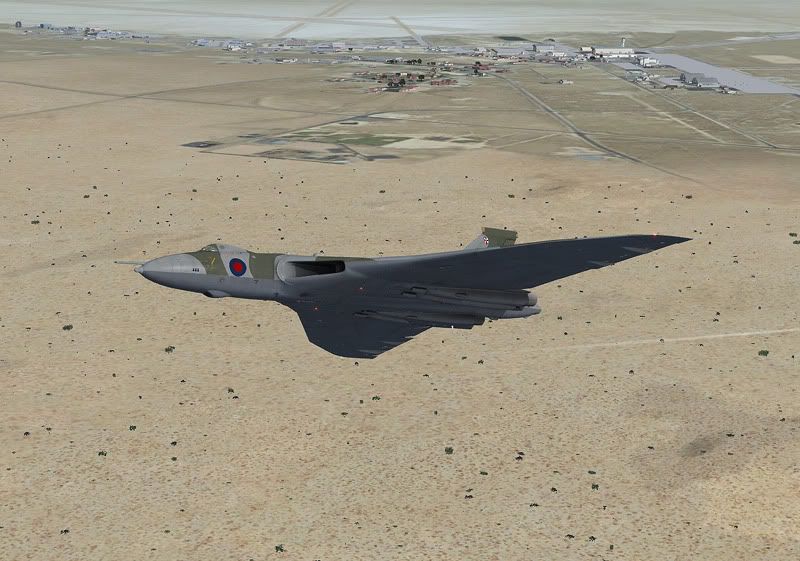
I did manage to get one screen shot of the event. Starting the long right hand climb...the runway is out of shot, parallel to that large grey hardstand in the top right of the picture.
All in all, a great if rather sweaty-palmed FSX experience.
Anyway, I thought I'd do it 'a la TVOC', and learn all the systems, print out the manual, run through what each and every dial, button and switch was for etc etc. I did this while the aircraft, XM607, was on the pan at Edwards AFB. All well and good, and I started to do some high speed taxi runs ( you know whats coming, don't you ) deploying airbrakes and brake chute and so on. I also started familiarizing myself with the radios and had NAV1 tuned to the ILS just to see how the yellow glideslope and localiser bars moved when I lined up in on the runway. What I had yet to do was learn anything about the autopilot system, which is a bit unusual, with things like Glide pull switch, channel switches, IAS/Altitude pull switch and so on. Save that for another day, I thought.
So there I was, barrelling down RW 22 for about the fourth or fifth time and, switching to external view, I thought I would just ease the nose wheel up a tad...just a little, just to see what it looked like. The inevitable happened; suddenly I was a few feet in the air, and I chopped the throttles...but too quickly, and not wanting to hit the tarmac too hard, I re-applied power to slow the descent. Wrong ! I started climbing again, and was running out of runway to put her down, so I had no choice but to go for a circuit. I did consider leaving the wheels down to try to arrest my speed, but feared damaging them, so up they came.
I could have pressed the ESC key and ended the flight, but pride got in the way, so put it in a gentle turn to the right, trimmed it out at around 4500 ft, and tried to keep the speed down below 250 knots. I then considered my options. The Vulcan is NOT a VFR aircraft. The view out of the cockpit is very limited, but not being au fait with the intricacies of the auto-pilot, the only way I was going to get it down was by hand and eye. Bear in mind, this was genuinely the first time I'd been airborne in the Iris Vulcan.
I continued the long right turn, looking out through the copilots side window to catch sight of the airfield as it receded down the starboard side. The only thing I did have in my favour was the fact that the NAV 1 radio was still tuned to the ILS frequency, and it was by a long long curve that I eventually lined up with the localiser. I was way below the glideslope and kept pushing the throttles far more than was required. Dropped the gear at 150 knots, but was once again at risk of undershooting. In trying to correct that ( and commiting the cardinal sin of using the stick instead of the throttles ),I started some rather severe pilot-induced oscillations. Nevertheless, I smoothed it out and if I say so myself, actually touched down quite sweetly...and almost bang on the centre line !
I did manage to get one screen shot of the event. Starting the long right hand climb...the runway is out of shot, parallel to that large grey hardstand in the top right of the picture.
All in all, a great if rather sweaty-palmed FSX experience.