
From what i understand is that below FL100 you have to have your landing lights on.
However earlier this year when the nights were dark i noticed an aircraft flying into my local airport at around 6-7pm with no logo light or landing lights. and clearly below FL100.
Which got me to think how strict is this rule and does it bring into question the piloting skills of that airline or pilot?
this went on for over a month
landing light rules
Moderators: Guru's, The Ministry
-
Garry Russell
- The Ministry
- Posts: 27180
- Joined: 29 Jan 2005, 00:53
- Location: On the other side of the wall


-
Garry Russell
- The Ministry
- Posts: 27180
- Joined: 29 Jan 2005, 00:53
- Location: On the other side of the wall
-
Prop Jockey

- Vulcan

- Posts: 418
- Joined: 23 Oct 2004, 22:59
- Location: EGLD
- Contact:
Hi All,
Depends on the country and the airline and the aircraft. I believe Easyjets 737's have the logo lights linked to the nav lights for instance - but if the bulbs go then they're not typically replaced until a check - whilst Nav light bulbs would be changed when found u/s. I don't use landing lights below FL100 in the UK, although I do use them on take-off (again no requirement - just the added advantage of advertising yourself to the local bird population). They're also useful at night to see what type of cloud or precipitation you're flying in. Strobes are another matter though - at night they go on with the final pre-takeoff checklist actioned with clearance to take-off and off again with the after-landers on vacating - they really screw your night vision so it's a courtesty thing too.
On some aircraft like the 737 - where the landing lights hinge down into the airflow - advice is not use them above 250kts becuase of exessive force on the hinges - so you might not use them if you get no ATC speed restrictions below FL100
Cheers
Rich
Depends on the country and the airline and the aircraft. I believe Easyjets 737's have the logo lights linked to the nav lights for instance - but if the bulbs go then they're not typically replaced until a check - whilst Nav light bulbs would be changed when found u/s. I don't use landing lights below FL100 in the UK, although I do use them on take-off (again no requirement - just the added advantage of advertising yourself to the local bird population). They're also useful at night to see what type of cloud or precipitation you're flying in. Strobes are another matter though - at night they go on with the final pre-takeoff checklist actioned with clearance to take-off and off again with the after-landers on vacating - they really screw your night vision so it's a courtesty thing too.
On some aircraft like the 737 - where the landing lights hinge down into the airflow - advice is not use them above 250kts becuase of exessive force on the hinges - so you might not use them if you get no ATC speed restrictions below FL100
Cheers
Rich

-
Chris Trott
- Vintage Pair

- Posts: 2592
- Joined: 26 Jun 2004, 05:16
- Location: Houston, Texas, USA
- Contact:
In the US, the rules are kinda odd. Technically, all that's required is that an electric landing lights be installed and operational (i.e. equipped) but there is no mention of it actually having to be used. However, most Airline Operations Manuals specify use of landing lights from dusk until dawn when in the terminal area (basically within 20 miles of the airport and below 10,000 feet) and many also specify the use of landing lights during the daytime in the same situation, although this is less "universal". There is technically no regulation that prevents an airliner from landing without landing lights, however you'll probably get a very lenghty investigation from the FAA to ensure that the landing lights are working and that it was REALLY necessary to land (or take off) with them off.
As for logo lights, I'm not sure where it originated specifically, but they were an airline-originated modification, not a factory option. Their use is governed by each individual Airline's Operating Manual, not by regulation similarly to landing lights. There have been a multitude of modifications and options over the years to light the tail, but the biggest purpose they serve isn't advertisement. Logo lights make for easier identification of aircraft at night while on the ground. The tail is a large surface that is easily identified at a distance while on the ground. By lighting it ATC and other aircraft can identify who it is (i.e. is it an American 767 or a United 767 that I'm following or to follow?). It's still not required and many airlines who buy used aircraft don't add them if they weren't already on the airplane. Some airlines also don't keep them working, but some do. I personally thank every mechanic to replaces them because there's times when it's not that easy to tell who you're trying to follow, especially when ATC tells you to follow a particular aircraft and it's pitch black and you're in a little Cessna versus a larger airplane.
As for logo lights, I'm not sure where it originated specifically, but they were an airline-originated modification, not a factory option. Their use is governed by each individual Airline's Operating Manual, not by regulation similarly to landing lights. There have been a multitude of modifications and options over the years to light the tail, but the biggest purpose they serve isn't advertisement. Logo lights make for easier identification of aircraft at night while on the ground. The tail is a large surface that is easily identified at a distance while on the ground. By lighting it ATC and other aircraft can identify who it is (i.e. is it an American 767 or a United 767 that I'm following or to follow?). It's still not required and many airlines who buy used aircraft don't add them if they weren't already on the airplane. Some airlines also don't keep them working, but some do. I personally thank every mechanic to replaces them because there's times when it's not that easy to tell who you're trying to follow, especially when ATC tells you to follow a particular aircraft and it's pitch black and you're in a little Cessna versus a larger airplane.
-
DispatchDragon

- Battle of Britain

- Posts: 4925
- Joined: 23 Feb 2005, 01:18
- Location: On the corner of walk and dont walk somewhere on US1
- Contact:
Chris is spot on about the logo lights - they are more for visibility that advertisment - our guys (per the AAY AOM) turn them on below 10000
inside the terminal area along with the landing lights (Rememeber an
MD80s landing lights are pie dish monstrosties just inbord of the wingtip
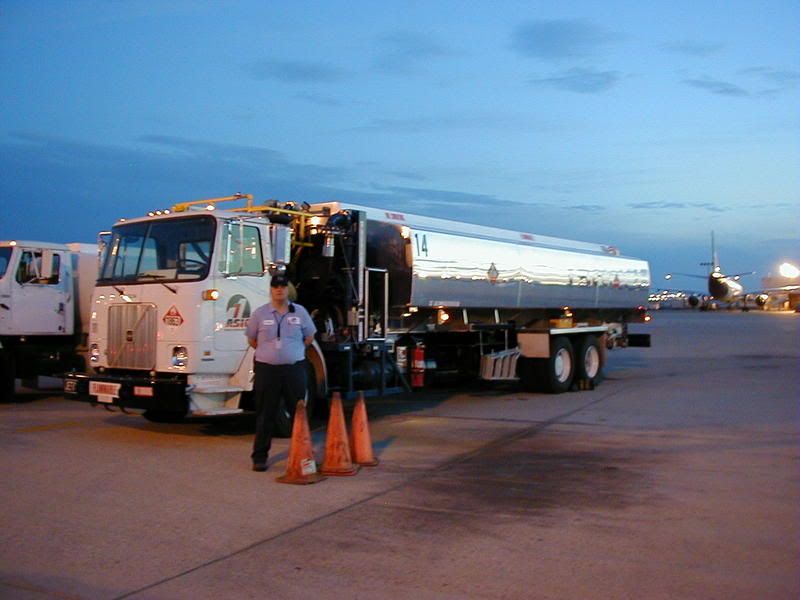
and are visible only in the forward quadrant through and angle of about 120 degrees so the logo lights make the aircraft much more visible from the side and rear. BTW we have more problems with logo lights overheating and burning out than landing lights as they are in little plastic fairing on the aft of the wing tip and are prone to frying in hot enviorments (Like LAS which is presently 45C) They are also (sorry Chris not trying to blame fuelers - but a perfect target for catering trucks, belt loaders and fuel trucks. As to lights and the law - in the case of an MD80
we can MEL lights but in incremements - frinstance you can have one or both wing laning lights out as long as the nose lights are working = we can have combinations of strobes, postion and nav lights out before we have to stop flying at night - you just have to sit and go through the Minimum equipment list and work out what combination you have and how it applies to night operation
Sorry didnt mean to be long winded - but hope that clears things up a little
Oh yes Logo lights are a 120 day MEL - so they can be inop for 4 months without being repaired - show you how important they are(n't)
Cheers
Leif
inside the terminal area along with the landing lights (Rememeber an
MD80s landing lights are pie dish monstrosties just inbord of the wingtip
and are visible only in the forward quadrant through and angle of about 120 degrees so the logo lights make the aircraft much more visible from the side and rear. BTW we have more problems with logo lights overheating and burning out than landing lights as they are in little plastic fairing on the aft of the wing tip and are prone to frying in hot enviorments (Like LAS which is presently 45C) They are also (sorry Chris not trying to blame fuelers - but a perfect target for catering trucks, belt loaders and fuel trucks. As to lights and the law - in the case of an MD80
we can MEL lights but in incremements - frinstance you can have one or both wing laning lights out as long as the nose lights are working = we can have combinations of strobes, postion and nav lights out before we have to stop flying at night - you just have to sit and go through the Minimum equipment list and work out what combination you have and how it applies to night operation
Sorry didnt mean to be long winded - but hope that clears things up a little
Oh yes Logo lights are a 120 day MEL - so they can be inop for 4 months without being repaired - show you how important they are(n't)
Cheers
Leif
-
Prop Jockey
- Vulcan
- Posts: 418
- Joined: 23 Oct 2004, 22:59
- Location: EGLD
- Contact:
..... And wasn't the night visibility of BA's 'World Tail' designs one of the nails in the coffin for them ? I seem to remember ATC weren't too keen regardless of whether they were lit up or not ? Interestingly the UK AIP currently states that a Landing Light is not even a mandated piece of equipment (as it is in the ICAO regs). However it also says "The process of amending the legislation has commenced". So we can all expect an update soon no doubt 
Cheers
Rich
Cheers
Rich
-
alan cottrill
- Trident

- Posts: 306
- Joined: 18 Apr 2006, 22:09
-
Motormouse

- Concorde

- Posts: 1347
- Joined: 09 Sep 2004, 22:03
- Location: In a Hangar
Re: landing light rules
In the US, yes, in europe and rest of world its' optionalunion79 wrote:From what i understand is that below FL100 you have to have your landing lights on.
However earlier this year when the nights were dark i noticed an aircraft flying into my local airport at around 6-7pm with no logo light or landing lights. and clearly below FL100.
Which got me to think how strict is this rule and does it bring into question the piloting skills of that airline or pilot?
this went on for over a month
ttfn
Pete
An Elephant is a Mouse designed to
a government specification.
a government specification.