There's a rather extraordinary picture of an F 18 at
http://antwrp.gsfc.nasa.gov/apod/ap070819.html
Sorry - not sure how to activate the link
Chris
Visible Sonic Boom
Moderators: Guru's, The Ministry
-
Garry Russell
- The Ministry
- Posts: 27180
- Joined: 29 Jan 2005, 00:53
- Location: On the other side of the wall
Re: Visible Sonic Boom
Thanks Chris
The links fine
Regards
Garry
The links fine
Regards
Garry
Garry
"In the world of virtual reality things are not always what they seem."
"In the world of virtual reality things are not always what they seem."
-
Quixoticish
- Concorde

- Posts: 1124
- Joined: 15 Oct 2005, 15:16
- Location: York
Re: Visible Sonic Boom
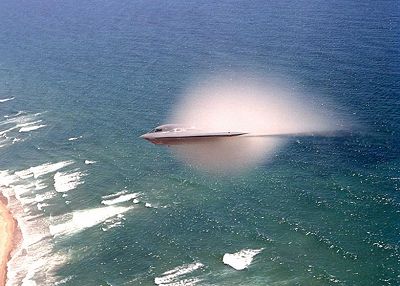
I've seen this touted as a "visible sonic boom" before but that isn't strictly true; they are known as Prandtl-Glauert singularities and can occur at subsonic and transonic speeds as well so aren't really a visible manifestation of the sound barrier even if the aircraft is breaking into supersonic flight at that particular moment in time.
It still looks incredibly cool though.
Edit :
It still looks incredibly cool though.
Edit :
-
DaveB

- The Ministry
- Posts: 30457
- Joined: 17 Jun 2004, 20:46
- Location: Pelsall, West Mids, UK
- Contact:
Re: Visible Sonic Boom
Incredibly cool indeed.. probably moreso on that B2 shot!! Looks like it's just coming out of a wormhole (I know.. I watch too much SciFi) 
ATB
DaveB :tab:
ATB
DaveB :tab:


Old sailors never die.. they just smell that way!


Re: Visible Sonic Boom
I always put such effects down to localised supersonic airflow over the aircraft's surfaces. It's often seen at UK airshow (where M0.92 is usually about the fastest anything goes IIRC). I've seen it on Lightnings and Tonka F3s during the 'fast' pass. tonka
I bet everybody has seen this before a million times, but this about as close as you can get to a visible sonic boom:
F14 on Youtube
Look at the shock wave on the water under the aircraft!
James
I bet everybody has seen this before a million times, but this about as close as you can get to a visible sonic boom:
F14 on Youtube
Look at the shock wave on the water under the aircraft!
James

-
Chris Trott
- Vintage Pair

- Posts: 2592
- Joined: 26 Jun 2004, 05:16
- Location: Houston, Texas, USA
- Contact:
Re: Visible Sonic Boom
I disagree. The cone is a visible representation of the "Sonic Barrier" as it is simply a condensation wave that is formed as the aircraft approaches the speed of sound in high humidity conditions and is created by the shockwave formed by the aircraft's nose causing the moisture in the much slower air beneath (actually in partial vacuum) to condense and create the "cone". When that cone reaches the rear of the plane, the aircraft has exceeded the speed of sound. It's a really good tool to show how close to the speed of sound a plane is actually. If the cone is at 1/2 the length of the aircraft, then it is around .90 Mach. From there it is a fairly linear movement aft as speed increases. I have had the rare pleasure of seeing the cone move from mid-length to tail as an F-16 went supersonic over Eastern Colorado on a rare humid day. As soon as the cone reached the tail it dissipated (nothing to disturb the airflow and maintain the conditions that allow for the condensation to form) and a sonic boom was heard for the first time.
I know that the display pilots here in the US will watch for the cone and try to perfectly position it on their aircraft during their high-speed fly-by by using their rear view mirrors as they know it makes for great photographs. On some aircraft it looks better further aft than on others. The B-1B is a perfect example where the cone looks best somewhere around 75-80% (about Mach 0.95) compared to the near 50% that looks good on most fighters.
I know that the display pilots here in the US will watch for the cone and try to perfectly position it on their aircraft during their high-speed fly-by by using their rear view mirrors as they know it makes for great photographs. On some aircraft it looks better further aft than on others. The B-1B is a perfect example where the cone looks best somewhere around 75-80% (about Mach 0.95) compared to the near 50% that looks good on most fighters.
-
Quixoticish
- Concorde
- Posts: 1124
- Joined: 15 Oct 2005, 15:16
- Location: York
Re: Visible Sonic Boom
To pull you up on a semantic point; a "visible representation of the sonic barrier" is arguably a very different thing to a "visible sonic boom", and from what I understand of the Prandtl-Glauert phenomenon it is certainly not the latter, although it could be construed as a representation of the former.Chris Trott wrote:I disagree. The cone is a visible representation of the "Sonic Barrier" as it is simply a condensation wave that is formed as the aircraft approaches the speed of sound in high humidity conditions and is created by the shockwave formed by the aircraft's nose causing the moisture in the much slower air beneath (actually in partial vacuum) to condense and create the "cone". When that cone reaches the rear of the plane, the aircraft has exceeded the speed of sound. It's a really good tool to show how close to the speed of sound a plane is actually. If the cone is at 1/2 the length of the aircraft, then it is around .90 Mach. From there it is a fairly linear movement aft as speed increases. I have had the rare pleasure of seeing the cone move from mid-length to tail as an F-16 went supersonic over Eastern Colorado on a rare humid day. As soon as the cone reached the tail it dissipated (nothing to disturb the airflow and maintain the conditions that allow for the condensation to form) and a sonic boom was heard for the first time.
I know that the display pilots here in the US will watch for the cone and try to perfectly position it on their aircraft during their high-speed fly-by by using their rear view mirrors as they know it makes for great photographs. On some aircraft it looks better further aft than on others. The B-1B is a perfect example where the cone looks best somewhere around 75-80% (about Mach 0.95) compared to the near 50% that looks good on most fighters.
-
Chris Trott
- Vintage Pair
- Posts: 2592
- Joined: 26 Jun 2004, 05:16
- Location: Houston, Texas, USA
- Contact:
Re: Visible Sonic Boom
I would agree that it would be more accurate to call it a "visual representation of the sonic barrier" instead of a "visible sonic boom", however, in the context of the photo being posted for the edification of those who are less-than-savvy on fluid dynamics and/or aerodynamics, it tells people what it is without having to go through a lenghty explanation of what Prandtl-Glauert phenomenon is and why it happens since the basics that will be understood are the same -
As the plane goes faster the "cone" moves further back along the airplane and when it's at the back, the plane is supersonic.
BTW - Any "sonic boom"-type or just plain "blown-up" smilies out there? Would be kinda funny to have one at the end of that last line that shows what happens when you get too close to one...
As the plane goes faster the "cone" moves further back along the airplane and when it's at the back, the plane is supersonic.

BTW - Any "sonic boom"-type or just plain "blown-up" smilies out there? Would be kinda funny to have one at the end of that last line that shows what happens when you get too close to one...
Re: Visible Sonic Boom
more effects of condensation (sorry it is modern metal and not supersonic approach to EGLL)


