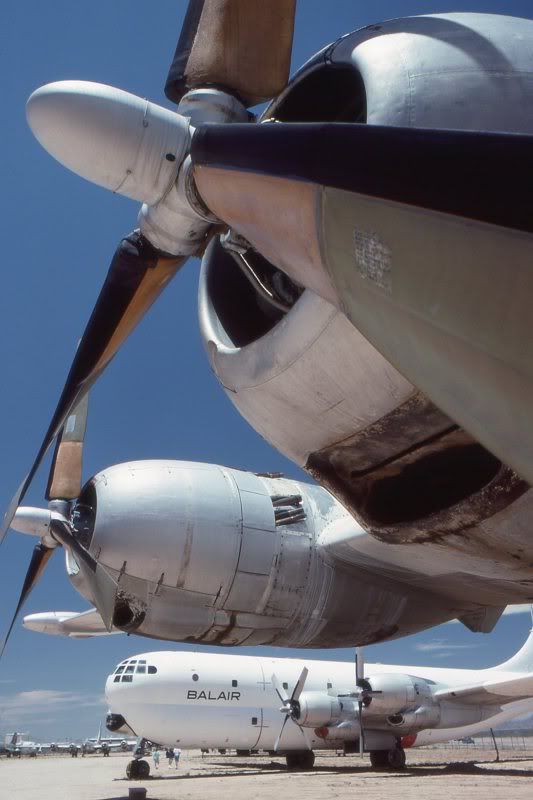
I meant to post this when the thread first started, but my scanner had gone **** up.. Its a coincidence it was published the same day as the thread started
Last edited by VC10 on 17 Feb 2008, 19:24, edited 1 time in total.
If God had meant us to fly, he would have given us tickets.
I've always had a fascination for ungainly looking types, and while they are 'ugly' to many, they also, I think, have a sort of majesty about them. In my eyes they are not ugly, just full of character!
But at least that Breguet, and similarly the Beverley, are quite curvacious shapes, so not as ugly as some more angular types.
Very interesting John.I seem to recall that she was known as the Breguet Deux Ponts which translates literally to two bridges but which I think colloqually means 'Double Decker'.I suspect that I will soon be corrected! EricT
Now at the age where I know I like girls but can't remember why!
Air France was at first reluctant to take them with American engines but they were plentiful with spares easily obtainable anywhere they were likely to go.
Quite a beast
Garry
Garry
"In the world of virtual reality things are not always what they seem."
The reason most of the post-war airplanes cruise nose level or slightly nose down is like legion said, mostly a function of aerodynamics. To achieve the slow-speed performance required to get off the shorter runways, a significant amount of incidence (usually around 3-5 degrees) had to be built into the wings. Because of this, when the airplane reached and accelerated to cruise conditions, the wing naturally moved to a low angle of attack as lift built and the fuselage rotated into its cruise position. As well, the designers felt that this orientation was more comfortable to passengers and stewardesses. With a piston wing, the lowest drag on the wing is at a 0 AoA, so that is why you got what you did. With a jet wing, a positive AoA is the lowest drag position.


 Its been a long week. In fact it was PoLts day today for me :sad: (not PoEts days).